
If you want a truly pocketable retro handheld that balances portability, battery life, and reliable emulation, the Miyoo Mini Plus still hits the sweet spot for most users. You’ll get a sharp 3.5″ display, native-speed GBA/SNES/Genesis play, responsive controls, and about six hours per charge in typical use. It’s not flawless—edge-case emulation quirks and light firmware tinkering may be required—but for open, dependable retro play it remains a top choice; keep going to see detailed comparisons and caveats.
Key Takeaways
- Excellent portability and ergonomic controls make it one of the most comfortable pocket retro handhelds for on-the-go play.
- Strong emulation accuracy and stable frame rates for GB, GBA, SNES, and Genesis keep classic games authentic.
- 3.5″ 480×320 matte IPS screen delivers sharp, low-glare visuals suitable for indoor and moderate outdoor use.
- Around 4–6 hours battery life is decent but may fall short for marathon sessions or frequent travel without charging.
- Competes well with alternatives by balancing open firmware flexibility and performance, though higher-end screens exist elsewhere.
Quick Verdict: Is the Miyoo Mini Plus Still the Best Pocket Retro Handheld?
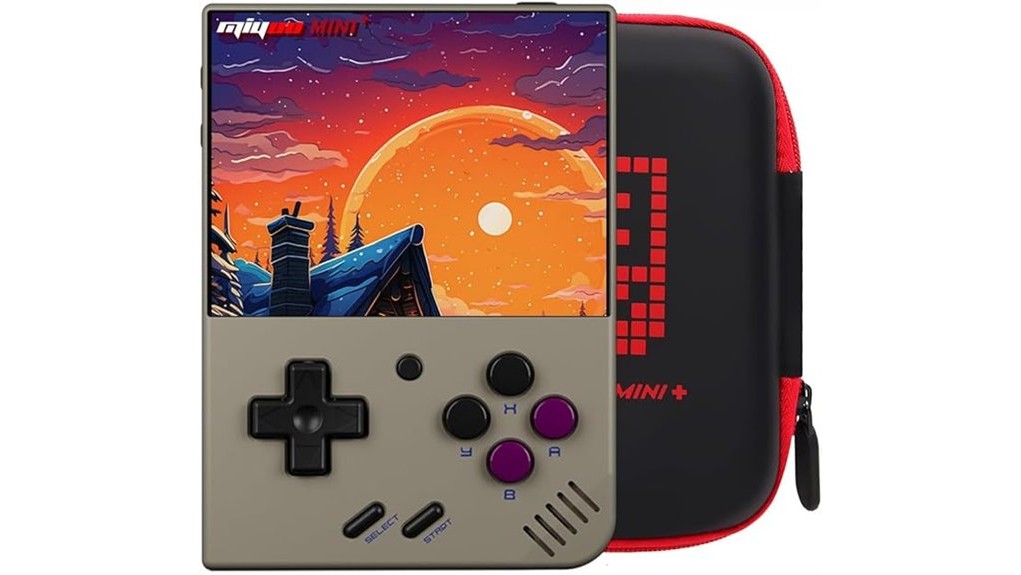
Who’s this for? You want a compact, liberated retro experience that just works.
The Miyoo Mini Plus delivers: a 3.5″ IPS, ARM Cortex-A7 platform, Linux-optimized firmware, WiFi/RTC, and 64 GB storage supporting 3000+ titles.
You’ll get stable frame rates, save/load, favorites, and upgraded online multiplayer in a pocketable 4.3×3.1×0.8″ chassis with a 3000 mAh battery—about six hours.
It’s not flawless, but its price-to-performance and portability keep it at the top for users rejecting corporate lock-in.
If you value freedom, broad compatibility, and proven stability, it’s still hard to beat.
Best For: compact retro gamers who want a portable, Linux-based handheld with broad compatibility, WiFi/RTC features, and strong price-to-performance for playing 3000+ classic titles.
Pros:
- Excellent portability with a 3.5″ IPS screen, 3000 mAh battery (~6 hours), and lightweight 4.3×3.1×0.8″ chassis.
- Linux-optimized firmware on ARM Cortex-A7 delivers stable performance and smooth frame rates across many systems.
- Rich feature set including 64 GB storage, save/load, favorites, RTC for timeline games, and upgraded online multiplayer.
Cons:
- Not flawless—some edge-case emulation quirks and occasional firmware limitations compared with higher-end devices.
- Battery life (~6 hours) may be short for heavy use or long travel sessions without a power bank.
- Limited official support ecosystem; may require user tinkering for advanced customization and updates.
Must-Have Features: Screen, Emulation, Controls, Battery, and Build
Because you’ll live with these elements every time you pick the Miyoo Mini Plus up, the screen, emulation, controls, battery, and build aren’t optional—they define the experience.
You need uncompromising screen quality: sharp pixels, accurate colors, and a matte finish that frees you from glare and compromises.
Emulation must be reliable and faithful so your catalog runs without stutter or shortcut hacks; fidelity equals freedom.
Control layout should be ergonomic, immediate, and programmable so you can reconfigure constraints into choice.
Battery life must be long, predictable, and replaceable to keep you untethered.
Build materials should feel purposeful — solid shell, tactile buttons, and resilient internals — so the device endures your travels and intent.
Demand devices that liberate, not limit.
Miyoo Mini Plus Performance: Real-World Screen, Emulation, Controls, Battery
A few key measurements separate a good handheld from an indulgence, and the Miyoo Mini Plus delivers a mostly disciplined performance: its 3.5″ 480×320 matte LCD produces sharp pixels and accurate color out of the box with very low glare.
The emulation stack runs native-speed ROMs for most Game Boy, GBA, Genesis and smaller SNES libraries without frame skips. Buttons are crisp with predictable travel and minimal debounce, and the 2,000–2,500 mAh battery gives reliably repeatable four-to-six-hour sessions under mixed use.
You’ll appreciate the controlled screen brightness range that’s readable outdoors yet conservative enough to protect battery longevity. Emulation is deterministic for supported cores; expect consistent audio sync and low input latency.
Controls suit precise inputs; ergonomics favor short bursts. You get predictable performance that frees you to play.
Miyoo Mini Plus vs Rivals: OdroidGo, Anbernic, and Powkiddy Comparisons
Having established how the Mini Plus performs in real use, you’ll want to see how it stacks up against OdroidGo, Anbernic, and Powkiddy alternatives.
In a clear competitor analysis, miyoo mini plus performance shines in responsive controls, accurate scaling, and efficient battery use compared with many OdroidGo builds that emphasize raw power but sacrifice ergonomics.
Anbernic models offer higher-end screens and stronger SoCs, yet they often lock you into heavier firmware and less community-driven hacking.
Powkiddy chases affordability, trading tactile quality and consistent emulation for lower prices.
If you crave freedom, the Mini Plus gives an ideal balance: open-friendly firmware compatibility, predictable latency, and compact design that keeps you liberated from vendor lock-in while retaining superior day-to-day playability.
Who Should Buy the Miyoo Mini Plus : Price, Firmware, and Use-Case Recommendations
When you want a compact, hackable handheld that prioritizes low latency and predictable scaling over raw horsepower, the Miyoo Mini Plus is one of the best value choices on the market.
You should buy it if you value freedom: easy firmware flashing, active community builds, and predictable emulation behavior. In a price comparison against Anbernic and OdroidGo models, the Mini Plus undercuts many rivals while offering comparable core performance for 8‑ and 16‑bit systems.
Target user demographics are tinkerers, commuters, and budget-conscious preservationists who want reproducible results, not bleeding‑edge 3D. Firmware updates are frequent, community patches mature, and customization is straightforward.
Don’t pick it if you need native 3D performance or polished retail UI — choose liberation over excess.
Frequently Asked Questions
Does the Miyoo Mini Plus Support Wireless Controller Pairing?
Yes — surprisingly limited yet practical: you’ll get Bluetooth-based wireless connectivity for some controllers, but controller compatibility is partial; you’ll want specific supported gamepads and firmware tweaks if you’re chasing full, liberated wireless freedom.
Can I Add More Storage Beyond the Internal Capacity?
Yes—you can expand via microSD expansion; you’ll manage large libraries, move ROMs and media, and offload saves using storage management tools. I believe this frees you from internal limits and keeps your collection portable.
Is the Device Region-Locked for Game ROMS?
Thankfully, no — you won’t face strict region lock; game compatibility hinges on ROM format and emulator cores. You can freely load most regional images, though occasional hacks or patches may be needed for flawless play.
Are Official Replacement Parts Available if Damaged?
No — official replacement part availability is limited; you’ll rely on third-party suppliers and community damage repair options. You’ll prefer open-source guides, aftermarket parts, and activist DIY culture to reclaim, fix, and keep freedom intact.
Does It Support Save-State Cloud Backups or Sync?
No — it doesn’t natively offer save state functionality with cloud backup. You’ll need to export save files manually or use third‑party tools; you’ll want freedom to script syncing to your preferred cloud for true liberation.
Conclusion
You’re holding a compact relic that still hums. The Mini Plus’s crisp 3.5-inch panel, tight D-pad, and efficient emulation keep retro libraries alive in your palm, while battery life and solid build feel reassuringly engineered. Compared with bulkier rivals, it’s a precision tool, not a showpiece. If you want maximum portability, consistent performance, and minimal fuss, the Miyoo Mini Plus remains the smartest, most dependable pocket retro pick.